Keynote Lectures
Keynote Lectures
We are pleased to announce that the keynote lectures for SIROCCO 2026 will be given by:
Dariusz R. Kowalski, Augusta University
2026 Prize for Innovation in Distributed Computing awardee
Dr. Dariusz Kowalski (https://www.augusta.edu/faculty/directory/view.php?id=DKOWALSKI) is a Professor in the School of Computer and Cyber Sciences at Augusta University, having joined the faculty in 2019 after a distinguished tenure at the University of Liverpool. He earned his Ph.D. in Computer Science from the University of Warsaw in 2001, specializing in the theoretical foundations of communication and coordination. His research interests center on distributed computing, fault-tolerant algorithms, and network security, with a particular focus on the efficiency and robustness of wireless and ad-hoc networks. A prolific scholar with over 150 peer-reviewed publications, Dr. Kowalski is this year’s recipient of the Prize for Innovation in Distributed Computing for his transformative contributions to distributed algorithms on shared channel
Talk title: Distributed Protocols on Shared Channels
Abstract: A shared channel is an abstract model framework to study autonomous processes that interact and receive feedback as a function of the states of interacting processes. It emerged more than 50 years ago in attempts to model first wireless and local networks, in renown works of Abramson on ALOHANET and of Metcalfe and Boggs on Ethernet. Both these communication settings assume that a message transmitted by a process (also called a station in this scenario) is received only if there is no other overlapping transmission. The primary performance measure is time complexity.
This talk reviews selected research directions following those prominent works. One of them is the impact of channel feedback on performance of the system; in other words, how the information stored at processes (e.g., messages to be transmitted or other types of local inputs) could be efficiently “recovered” from feedback received during an execution of a distributed protocol. Examples of such study include radio networks with/out collision detection, beeping model, SINR networks, optical networks.
Another reviewed aspect of shared channels are dependent channels, typically modeled as spacial, graphical or hypergraph (e.g., modeling multi-frequency) multi-hop networks, in which every neighborhood follows the rules of a shared channel. Here, however, a station initiating some action, e.g., packet transmission, automatically interacts in channels associated with the surrounding neighborhoods. This creates an additional challenge of coordinating simultaneous activities in overlapping neighborhoods.
While a vast majority of theoretical work focuses on slotted synchronized settings, in reality clock shifts or even a (bounded) asynchrony may occur. We give examples of different impacts that these features may have on system performance or, in some cases, tasks’ feasibility.
The last discussed aspect of shared channels targets continuity and stability of shared channel communication. In particular, when the states/inputs of the processes may change dynamically by intervention of external stochastic/adversarial forces. Example includes packets injected dynamically to the processes, which then have to be successfully transmitted on the channel. The goal is to assure bounded packets’ latencies (and thus, bounded queue sizes at stations) for as high packet injection rate as possible, no matter how long the execution continues.
For each of the abovementioned aspects, major results and open directions will be presented.
Due to time limitation, this talk will not be able to cover many other features related to shared channels, such as fault-tolerance, security, equilibria, labeling schemes, quantum communication, energy efficiency, applications in shared memory, transactional memory, blockchains, etc. As well as relationships of shared channels with information theory and codes, communication complexity, (group) testing, machine learning, databases and other areas of computer science. For some of them, though, examples and references will be provided.
Maria Potop-Butucaru, Sorbonne University
Maria Potop-Butucaru (https://lip6.fr/Maria.Potop-Butucaru) has been a full professor at the Sorbonne University since 2012. She received her BSc in Computer Science in 1996 from University Al. I Cuza, Iasi, Romania, and her MSc in 1997 jointly from University Al. I Cuza and Paris XI University, Orsay, France. She received her PhD in 2000 from Paris XI University, France. She was Associate Professor in University Rennes 1 from 2001 to 2006, then Associate Professor at Sorbonne University (former Pierre and Marie Curie University) from 2006 to 2011. Her research interests are distributed systems resilient to multi faults and attacks (crash, Byzantine, transient, etc.). She is interested in self* (self-organizing, selfhealing, and self-stabilizing) and secure static and dynamic distributed systems (e.g., blockchains, peer-to-peer networks, sensors, and robot networks). She served as PC member, chair, or general chair for several venues in distributed computing SSS, OPODIS, DISC, PODC, etc. She co-initiated the Tokenomics series of conferences in order to bring together economists and computer scientists interested in blockchain technologies and decentralized finance.
Talk title: Smart Contracts and Distributed Cross-Chain Protocols
Abstract: Many challenges in blockchains and decentralized finance can be understood as modern variations of classical distributed computing problems. This talk introduces a smart contract model that highlights both the parallels and the key distinctions between traditional distributed systems and blockchain-based environments.
The discussion centers on cross-chain protocols, where multiple parties—some honest, others potentially adversarial—interact through trusted smart contracts deployed across independent ledgers. While these protocols are capable of supporting general computation, their primary application lies in managing ownership of assets such as cryptocurrencies and other valuable data.
This asset-centric focus leads to important differences from classical models of distributed and concurrent computing. In particular, because participants may behave in a Byzantine manner, problems are framed using fundamental game-theoretic concepts that account for each party’s incentives and possible outcomes.
As in traditional settings, parties provide inputs and agree on a sequence of intended asset transfers. However, unlike classical systems, it is the smart contracts—not the participants—that ultimately determine the outcomes by executing these transfers, as they alone control asset ownership.
Jukka Suomela, Aalto University
Jukka Suomela (https://jukkasuomela.fi/) is a Professor in the Department of Computer Science at Aalto University, Finland. His research focuses on the theoretical foundations of distributed and parallel computing, with a particular emphasis on the concept of locality. He served as the PC chair of DISC 2019 and SIROCCO 2016, and as one of the local chairs of ALGO 2018. He is currently a member of the EATCS Council, he chaired the DISC steering committee from 2022 to 2024, and he has also served on the steering committees of SIROCCO and SWAT. He has received the FOCS 2019 Best Paper Award, the DISC 2012 and 2017 Best Paper Awards, and several teaching awards.
Talk title: Distributed Quantum Advantage
Abstract: How much room is there for quantum advantage in the distributed setting? If we have a large computer network, and we replace classical computers with quantum computers and classical communication links with quantum communication links, can we solve some distributed tasks asymptotically faster? In particular, can we reduce the number of communication rounds? Formally, is the quantum-LOCAL model asymptotically stronger than the classical LOCAL model?
In recent years, we have made substantial progress in understanding this question, and an intriguing picture has emerged. On the one hand, we can now show that there are distributed graph problems that admit a quantum advantage. On the other hand, all known examples of such tasks are artificial problems, designed only to demonstrate a provable quantum advantage, and serving no practical purpose beyond that.
In this talk, I will give an overview of the state of the art in this area. I will survey techniques that we can use to place limits on quantum advantage; in particular, I will discuss non-signaling arguments that conveniently allow us to establish such limits without directly dealing with quantum computation. I will give examples of artificial problems that admit quantum advantage, and I will also discuss key barriers that prevent us from understanding, for example, quantum advantage for symmetry-breaking tasks.
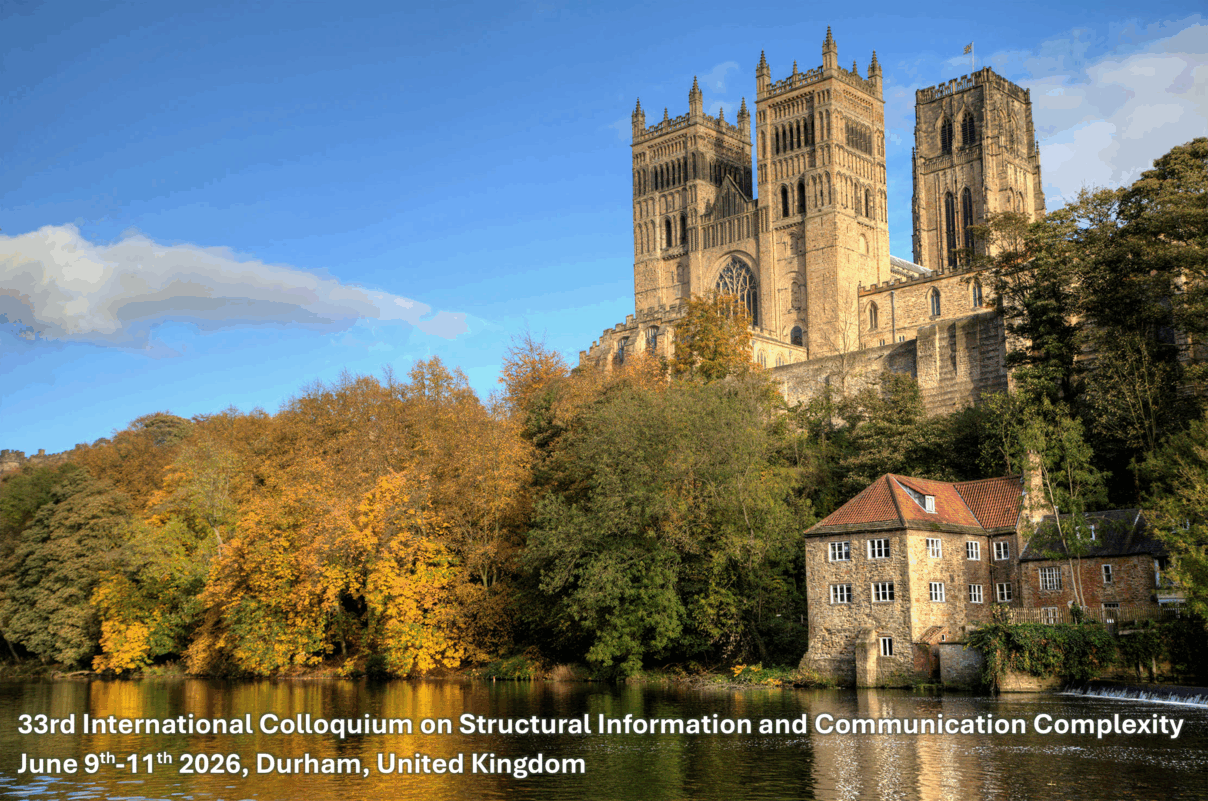
Supporters of SIROCCO 2026